
A Few Hundred Acres in Hayden
Three offices are arguing over the same street. The city council that declined the enhanced law-enforcement contract wants control of its own response times and its own budget. The sheriff’s office that has been supplying the deputies wants either a contract that covers the real cost or the freedom to redeploy the people. The county commission that sets both the contract terms and the land-use rules wants the revenue hole closed and the residual obligation clarified. Each side is protecting what it already has. None of them is creating anything new.
That is the expensive part. When the only options are “pay more,” “accept less,” or “stand up a department and raise taxes,” the argument stays inside a fixed pot of money. Property-tax capacity is limited. Contract arithmetic is limited. The political tolerance for either is limited. The fight continues because every gain for one office is a loss for another.
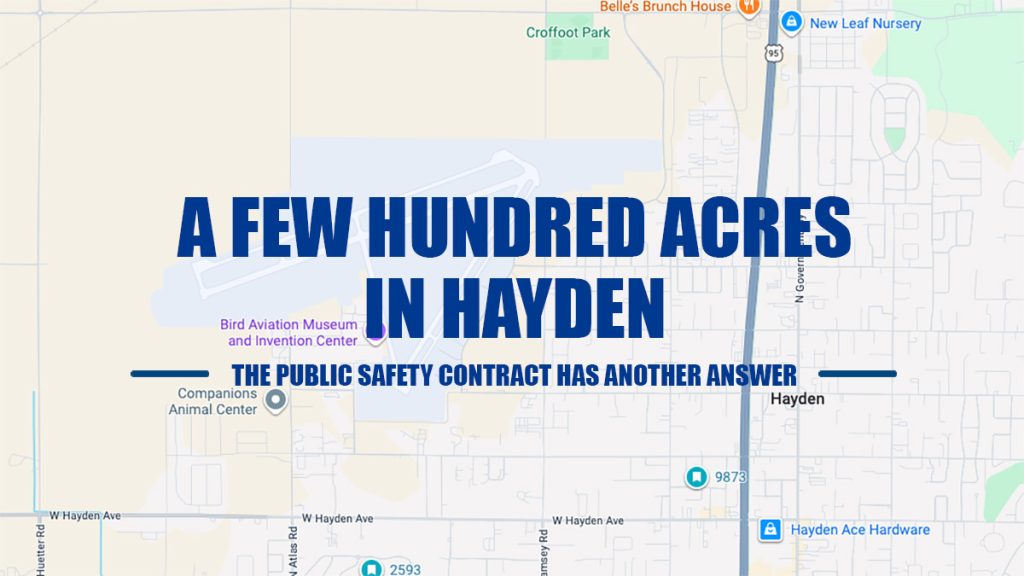
There is a different ledger. A few hundred acres of undeveloped or lightly developed land sit in and around the city limits near the airport. Some of it already carries industrial zoning or has carried it in the past. Airport safety zones constrain height and density, but they do not forbid light industrial or technology uses outside the strictest protection areas. The city can acquire a suitable block of that land—by purchase, by partnership, or by long-term control—issue debt sized to build a police station and secure the acreage, and place the surplus land under long-term ground leases.
Idaho cities already finance police facilities this way. A general-obligation bond requires a two-thirds vote and is repaid by a dedicated levy; certificates of participation can be structured as annual appropriations. Separately, the industrial-development statutes let a city create a public corporation that issues revenue bonds repaid only from the rents and payments generated by the project itself. Those bonds do not pledge the city’s full faith and credit. The station is a cost. The remaining land is the income that services the debt and, after the bond is retired, becomes ongoing revenue.
The numbers are ordinary industrial math, not speculation. Ground leases on secondary-market industrial land in the region can support several thousand dollars per acre per year with escalators. On 150 to 180 leasable acres after the station footprint is reserved, that range produces annual base rent measured in the low millions once occupancy is reached—enough, in principle, to cover debt service on a land-plus-station package and later to fund department operations. Buildings the tenants construct also add to the property-tax base. The city’s share is not the full levy, but it is still new money.
The same arithmetic changes the staffing picture. The current enhanced contract allocates four deputies, a compliance officer, an animal-control officer, and a part-time detective. A city department sized to the analysis already in circulation would employ at least twelve officers and four staff. That is a net increase in local public-safety positions, not a reduction. Deputies and support staff whose assignments are tied to the contract would have a lateral path into the new department rather than a pink slip. The sheriff’s office keeps its baseline county responsibilities and loses only the contested enhanced package; the people who have been working those streets can keep working them under a different patch if they choose.
Each office gains something it does not have today. The city council gets a permanent revenue stream sized to the department it wants instead of a permanent argument over contract line items. It also gets land-use control inside its own limits; the county ordinance that restricts certain facilities in the unincorporated area does not govern city land. The city can write the standards it needs—closed-loop cooling, moderate scale, setbacks—without waiting for anyone else. The county commission exits the contract-revenue hole and the residual staffing dispute. If any county or airport land is useful to the project, the commission can participate as a ground landlord or infrastructure partner and share in the developed tax base. Amending or narrowing the county’s own rules becomes optional rather than mandatory; the city can proceed on city land either way. The sheriff’s office is relieved of an enhanced-contract arrangement whose cost and accountability have been contested. Baseline county responsibilities remain. Any specialized or overflow support can be negotiated later on clearer terms, without the current fight over who is paying for whose deputies. And the officers who have been assigned to the city are not stranded; the new department’s larger roster creates room for them.
None of this requires one office to surrender its authority. It requires the three of them to stop treating the problem as a division of existing dollars and start treating a block of land as a shared balance sheet. The mechanism is standard public finance: one instrument for the station and the land it needs, pledged ground leases or a revenue bond for repayment, ordinary industrial tenants on the surplus acreage. Bond counsel, a realistic lease-up schedule, and airport-overlay limits are the ordinary constraints. They are not barriers that make the approach impossible.
The alternative is to keep negotiating the same contract, the same levy, and the same residual obligation. That path has already produced a rejected agreement and an open question about who patrols the streets after the current term ends. The land is still there. The statutes that let a city buy it, finance a station on it, and lease the rest are still there. The officers who already know the streets are still there. The only missing piece is the decision to use the land instead of continuing the three-way argument over a fixed pot of money.
I have sat in the meetings where the only tools on the table are a higher levy, a larger contract, or a smaller presence on the street. Each option asks the same question: which existing taxpayer writes a larger check so the same work can continue. That framing is short-sighted. It treats public safety as a pure cost to be shifted among offices rather than a service that can be paired with an asset capable of paying its own way. It is also the reflex of a system that reaches first for the tax base and only later, if at all, for the balance sheet.
There is another habit available. A city can acquire land, finance a station on part of it, and lease the rest on ordinary commercial terms. The tenants who need the ground pay rent. The rent retires the debt. After the bond is gone the same ground continues to produce income that can fund the department. No new permanent levy is required for the operating cost the leases cover. The officers already assigned to the city have a larger roster to join rather than a smaller one to leave. The county commission and the sheriff’s office exit a contested contract without surrendering their remaining duties. That is not a subsidy or a special carve-out. It is the ordinary use of land, debt, and a lease—tools every private owner already understands.
Elected offices do not have to invent a new theory of government to try it. They only have to stop treating the problem as a division of taxes and start treating a few hundred acres as capital. Capitalism is not a slogan here; it is the mechanism that turns undeveloped ground into a revenue stream large enough to change the argument. The American practice has long been to let productive assets carry public burdens when they can, rather than to default to the levy every time a budget gap appears. The land near the airport is still available. The statutes that let a city buy it and lease it are still on the books. The only decision left is whether the three offices will keep meeting to reallocate the same dollars or will put the ground to work so the dollars no longer have to be reallocated.
The same ground lease that retires a police-station bond can do more than keep deputies on the street. A tech-focused industrial center on the surplus acres can host robotics firms, AI development shops, and the modest compute nodes those businesses need. The preference is for micro-scale facilities that use closed-loop or dry cooling rather than the millions of gallons associated with hyperscale campuses. Power stays moderate. Water use stays near zero. What arrives is a cluster of employers building machines, writing code, and training models—and paying well above the local median.
Those firms also gain something most inland industrial parks cannot offer: the Coeur d’Alene Airport sits immediately adjacent. A finished robot, a prototype, or a high-value component can move from the loading dock to a cargo flight and reach almost any airport in the world without a long truck haul to a larger hub. For businesses whose products are small, expensive, and time-sensitive, that proximity is not a minor convenience. It is part of the reason a company chooses the site.
Those paychecks do not stay inside the buildings. They show up at the hardware store, the restaurant, the real-estate office, and the tax roll. A household earning the wages typical of robotics technicians, AI engineers, or systems administrators spends differently than a household at the county median. The difference compounds across contractors, retail, and services the way any other high-wage industry does.
The deeper effect is on the schools that feed the workforce. North Idaho College and the University of Idaho already sit inside commuting distance. A local demand for people who can design industrial robots, harden AI systems, or maintain secure networks gives both institutions a concrete reason to expand certificate and degree offerings in those fields. Students who can see a local job at the end of the course stay. The ones who leave still carry the credential. Either way the pipeline exists because the jobs exist.
That pipeline reaches the elementary schools. Atlas Elementary currently shows 59 percent of students proficient in math and 71 percent in reading. Hayden Meadows shows 73 percent and 74 percent. Hayden Canyon Charter sits nearby. Those figures are stronger than many other schools in the county, yet they are well below the high 80s and low 90s the same buildings posted in 2012 and earlier. A community that employs people who work with robots, algorithms, and secure systems creates a visible reason for a third-grader to treat math as useful rather than abstract. Parents who earn more have more margin for tutoring, for after-school programs, and for simply being home at a reasonable hour. The schools do not improve because a bond is passed; they improve because the adults around the children are doing work that rewards the skills the schools teach.
None of this requires the city to operate a university or to pick winners among tech firms. It requires the city to control a few hundred acres, zone them for moderate-scale industrial and technology uses, and lease the ground on ordinary commercial terms. The tenants who need power, fiber, airport access, and space for assembly lines or server racks pay the rent. The rent pays for the police station. The jobs and the classes follow the rent. The elementary proficiency numbers have a reason to climb again because the work the children will one day do is already being done a few miles away.
That is the capitalism the three offices have not yet tried. It does not ask which taxpayer writes a larger check. It asks whether a block of land can be put to work so the check is written by the businesses that use the land. The deputies stay. The station gets built. The schools get a local reason to aim higher. The only missing decision is whether the offices will keep meeting to reallocate the same dollars or will let the ground leases create new ones.
The fight over who pays can continue. Or the offices can choose the older American method: own an asset, lease it, and let the rent do part of the public’s work. That choice does not require anyone to abandon their post. It only requires them to remember that a balance sheet is also a form of governance.
If you liked what you read, please share with your social network! Thanks.