
One Engine Short, They Went Anyway
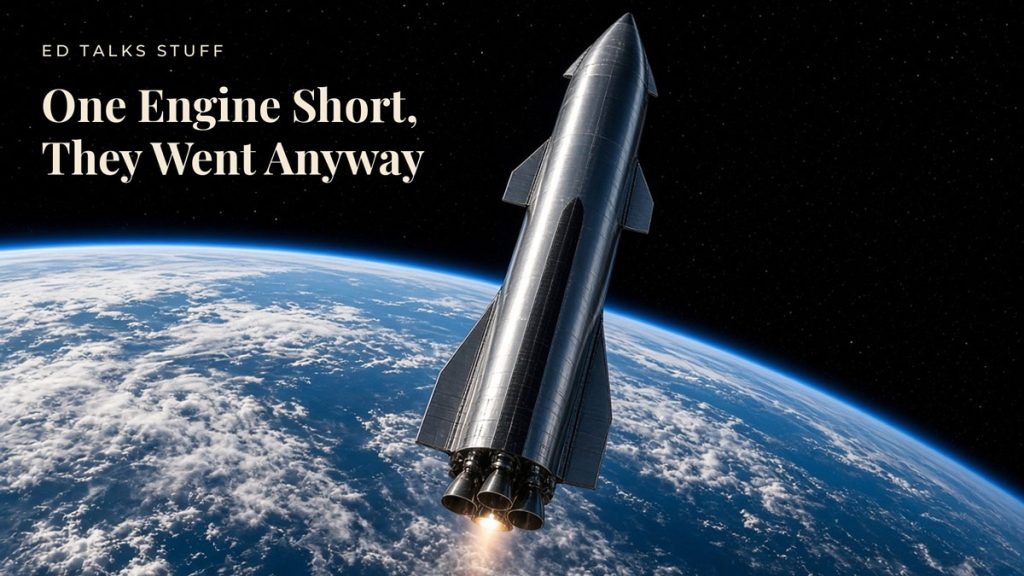
I was in my office when a Texas sky lit up this morning and a ship the size of a building decided that one dead engine was not an excuse to sit down.
SpaceX launched Starship from Starbase. Fourteenth time they have stacked the whole machine and lit it. First time the upper stage actually went into orbit. Somewhere on the way up, after the booster let go, one of the six engines on the ship quit. For a few minutes the people on the microphone thought that was the end of the orbital attempt. Then the engineers looked at what was still running, changed their minds, and burned for orbit anyway.
The ship made it. It pushed out twenty-six of the new Starlink satellites — the big ones that will not fit on the rocket they already fly every week — and the company said it had contact with all of them. They brought the ship home early, into a patch of Pacific they had already cleared, instead of riding the full ten-hour plan. That is not a failure. That is a machine that finished the job that mattered and then came back when the remaining engines said that was the adult call.
I sat there like a boy who still cannot believe the country builds things this large on purpose.
I Was Too Young for the Footprint. I Was Not Too Young for the Story.
I remember astronauts stepping onto the moon.
I was very young. Born in 1968 in San Jose. The first landing was a year later. I do not have a clean home-movie of that night in my head. What I have is the aftertaste that followed me through school: a country that had put a man on another world and then expected the rest of us to live like it was still possible. Teachers talked about it the way some families talk about a war an uncle actually fought. It was not trivia. It was a claim about what kind of people we were.
I remember the Space Shuttle Enterprise riding on the back of a 747. A white orbiter that could not go to space yet, practicing the landing the way a man practices a hymn before Sunday. I remember the first real launch into orbit in 1981. Columbia. The stack looking impossible on the pad, then the pad becoming a column of steam, then a machine that was supposed to fly like an airliner and come home.
I remember the first one that killed seven.
Challenger, January of 1986. I was seventeen. You do not forget the shape of that morning even if you have spent forty years trying to file it somewhere decent. The country stopped. NASA grounded the fleet for thirty-two months. After Columbia broke up on the way home in 2003, they stopped again for more than two years. After they retired the shuttle in 2011, the United States did not have its own way to put astronauts on the station it had helped build. We bought seats. We waited. We wrote reports.
I never lost the fascination. What I lost, for stretches, was the feeling that the fascination had a pulse. When something went wrong, the official answer was a pause long enough for a child to grow up.
The Pause Used to Be the Policy
I am not sneering at the dead.
Seven families after Challenger. Seven more after Columbia. You investigate. You fix the joint. You fix the foam. You do not treat a funeral as a press opportunity and light the next stack the following Tuesday. That is not courage. That is vanity.
What I am talking about is the other habit that grew up around those funerals. The habit of treating every hard thing as a reason to freeze the whole project until the feeling in the building improved. Progress became something you scheduled after the hearings. The West was not built that way. Life out there was dangerous. People died on the trail. Settlers still pointed the wagons at the horizon and went, because the alternative was to decide that risk itself was the enemy and stay where the soil was already spoken for.
NASA did extraordinary work. It also taught a generation of us that the price of a bad day was years of silence. SpaceX is running the other experiment in public. Blow a prototype up. Film it. Say what broke. Weld the next one. Fly again before the comment section has finished the eulogy.
That is not recklessness dressed up as a brand. That is how you find out what a new machine actually is. The shuttle was declared operational after four flights and then asked to behave like an airliner. Starship has been treated, from the first ugly hop, like a test article that would have to earn orbit the long way. This morning it did.
What This Morning Actually Was
Strip the livestream of the adjectives.
A forty-story stack left south Texas. The booster did its job and dropped into the Gulf. The ship lost an engine and still had enough healthy ones to finish the burn that makes a flight into a trip around the world. Twenty-six satellites left the bay. Those satellites are not souvenirs. They are the reason this flight was more than a pretty arc. They are hardware somebody had already paid to build, sitting in a vehicle that had never been to orbit, and they made it. That is millions of dollars that did not become a headline about debris.
Then the team looked at the rest of the day, decided not to press a wounded ship through six full laps for the sake of the brochure, and aimed it at water they had already warned the world about.
That sequence is the whole argument.
They did not pretend the engine was fine. They did not scrap the payload because a meter went red. They did not hold a two-year wake. They flew the mission that was still flyable.
Fear has no place in that room. Caution does. Those are not the same word, though a lot of coverage uses them as if they were.
What It Means If You Do Not Live at the Pad
I do not need Starship to make my coffee. I need what the flight does to the story a country tells itself about hard work.
For a long time the official story after a failure was: sit down. The new story is: keep the parts that work, write down the part that did not, and go again while the welders still remember the last stack. That sounds like a space paragraph. It is also a paragraph about bridges, power, factories, and whether a town is allowed to build the next necessary ugly thing without a year of theater first.
An interplanetary species is a grand sentence. I will use a smaller one. A country that can put a crippled ship into orbit and still deliver the cargo is a country that has not forgotten how it got across the prairie. The wagon train was not a safety seminar. It was a bet that the destination was worth the graves you might have to dig on the way. We have spent a few decades talking as if the graves were the argument against going.
SpaceX is racing toward a human presence on more than one world. NASA is a customer on some of that work, which is the right relationship if you want an agency that explores and a company that iterates. I am not here to pick a contractor. I am here to say that watching the cadence — fail, film, fix, fly — feels like the country I was told about in school. The one that did not treat the horizon as a liability.
Kids who watched this morning did not watch a memorial. They watched a machine with a problem finish the job. That picture will follow them the way the moon followed me. I would rather they inherit that picture than the one where the grown-ups lock the hangar and call it wisdom.
I Will Not See the Flag
I will most likely not be alive when a crew stands on Mars.
I have written here about the heart I actually have. I do not pick the last day. I only get the ones before it. A landing on another planet is a young man’s calendar, or a lucky old one’s. I am fifty-eight. I can do the arithmetic without making a speech out of it.
What I get is the steps.
A piggyback test in 1977. A first orbit in 1981. A hole in the sky in 1986. Years of quiet. A retired shuttle and a ticket on somebody else’s spacecraft. Then a private company that decided the quiet was the part that needed breaking. Then, this morning, a ship that was supposed to need every engine and discovered it did not.
I get a thrill out of every one of those steps. Not because I am collecting mission patches. Because a man who was told, as a boy, that his country goes, still wants evidence that the sentence is in force.
I do not need to stand in the dust to believe the dust is the point. I need to watch the people who build the next wagon refuse to turn around because the trail got ugly.
They went anyway.
That is the oldest American technology there is. The hardware changes. The habit is the tool.
If you liked what you read, please share with your social network! Thanks.