
Trade With Canada Is a Choice, Not a Necessity
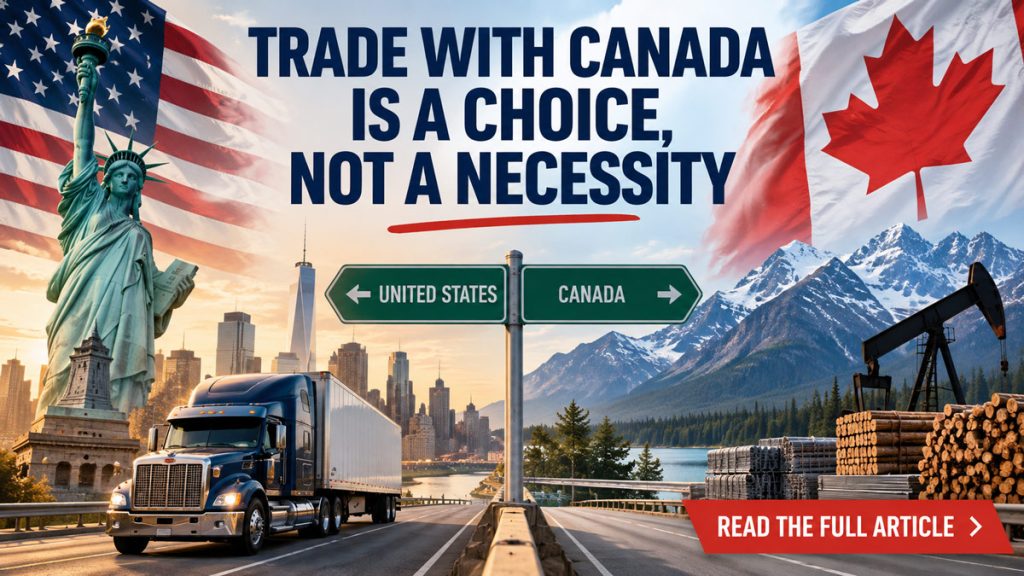
I keep reading stories about trade between the United States and Canada that leave me wondering when America became incapable of doing anything for itself. We need Canadian oil. We need Canadian lumber. We need Canadian aluminum. We need Canadian auto parts. If relations with Canada deteriorate, we’re repeatedly warned about the terrible consequences awaiting American consumers and businesses. You could almost come away believing somebody would turn off the lights in America if a truck from Ontario failed to show up Tuesday morning.
I don’t buy it.
That doesn’t mean I dislike Canada, nor am I suggesting we stop trading with our neighbor. Canada is an important trading partner, and geography alone makes a healthy trading relationship beneficial to both countries. But “important trading partner” and “country we cannot survive without” are two entirely different things, and lately I think we’ve been doing a lousy job distinguishing between the two.
Trade Is Supposed to Benefit Both Sides
America bought hundreds of billions of dollars of Canadian goods in 2024, and Canada bought hundreds of billions of dollars of American goods. That’s exactly what you’d expect between two wealthy countries sharing the world’s longest international border. Yet there is an enormous difference in what those numbers mean to the two economies.
Statistics Canada estimates that production serving American demand accounted for 15.9 percent of Canada’s GDP in 2024 and supported more than 2.5 million Canadian jobs. Think about that for a moment. Roughly one-sixth of Canada’s economy is connected to satisfying American demand. American exports to Canada, by comparison, represent only a small percentage of the enormous U.S. economy.
That doesn’t make Canada weak or America superior. It simply means the economic relationship isn’t symmetrical. Yet you wouldn’t necessarily know that from some of the reporting surrounding our current trade disputes.
Importing Something Doesn’t Mean We Can’t Make It
This is the part of the conversation that frustrates me most. America imports Canadian oil, so apparently America is dependent upon Canadian oil. Why?
The United States is one of the world’s largest oil-producing nations. We have enormous energy resources of our own, and we also have access to oil from other producing countries. Venezuela alone possesses enormous reserves of the heavy crude particularly useful to certain American refineries. Would replacing four million barrels a day of Canadian crude happen overnight? Of course not. But why is “overnight” the test?
Refineries can be modified. Pipelines can be built. Mines can be opened. Factories can be expanded. Regulations can be changed. Permitting can be accelerated. Capital moves when there’s money to be made. America imports something because, under current economic conditions, importing it makes sense. That is not proof America is incapable of producing it or finding another supplier.
We’ve somehow started treating existing supply chains as laws of physics. They aren’t.
Automobiles may be my favorite example. I’m repeatedly told how hopelessly intertwined the American and Canadian automobile industries have become. Parts cross the border. Engines cross the border. Vehicles cross the border. All true. But somehow the conclusion becomes that America couldn’t manufacture automobiles without Canada.
That’s nonsense. The American automobile industry helped create Canada’s automobile industry more than a century ago. Ford established Canadian operations in 1904, followed by other American manufacturers as the continental industry developed. Today’s integrated North American manufacturing system exists because companies spent decades designing their supply chains around the trade rules available to them. Change those rules and businesses will eventually change their supply chains.
There would be costs and disruptions. Some vehicles might become more expensive, and new factories and suppliers would require investment. But are we seriously suggesting a nation capable of building aircraft carriers, jet fighters, rockets, semiconductor plants and millions of automobiles every year somehow lacks the ability to manufacture the components currently coming across the Canadian border? I have a hard time accepting that argument.
Canada Isn’t Irreplaceable — And Neither Are We
Here’s where I think both sides should calm down. Canada could survive without the United States. It would hurt badly. Canada would need new customers, new transportation infrastructure and probably years of economic restructuring, but Canadians are perfectly capable people living in a resource-rich developed nation. They would adapt.
America would survive without Canada too. We’d find other suppliers, increase domestic production, redesign supply chains and build things we currently find cheaper to import. Prices would adjust, businesses would invest, and markets would respond. We’d adapt too.
That doesn’t mean I want either country to go through that exercise. Quite the opposite. Recognizing that neither country is indispensable to the other should make reasonable trade agreements easier, not harder.
I’ve increasingly questioned whether enormous free-trade agreements are always the best way to manage international commerce. Suppose Canada wants to protect its dairy industry. Fine. Canada is a sovereign nation. If Canadians decide protecting Canadian dairy farmers is worth restricting American dairy products, that’s their decision.
But America should have the same freedom. If we’re going to give Canadian automobiles unrestricted access to American consumers, perhaps American negotiators should be asking what American producers receive in return. I don’t necessarily want one gigantic agreement attempting to make thousands of industries fit under the same rules. Maybe governments should be able to look at individual markets and say: Here’s what you’re selling us, here’s what we’re selling you, here are the barriers you’re putting in front of our producers, and now let’s negotiate.
That isn’t anti-trade. That’s trade.
Fear Is a Terrible Negotiating Position
This is ultimately what bothers me about the way these disputes are discussed. Every time somebody proposes changing a trade relationship, we’re immediately presented with everything terrible that could happen to America. Gas prices could increase, cars could cost more, lumber could become more expensive and factories could experience shortages. Those are all possibilities worth considering.
But there’s another side of the equation that deserves equal attention: What happens to the country that loses access to roughly 340 million American consumers and the world’s largest consumer market?
That’s negotiating leverage too. If Americans constantly announce that we couldn’t possibly survive without every existing supplier, why would anyone negotiating against us believe they need to compromise?
I hope Canada prospers. I hope Canadians buy enormous quantities of American products, and I hope Americans continue buying Canadian products whenever those products provide the best combination of price, quality and availability. I want the same relationship with Mexico, Europe, Japan and everyone else willing to trade fairly with us.
But healthy relationships aren’t built upon one party believing it can’t live without the other. They’re built upon mutual benefit.
America doesn’t need to threaten the world. We don’t need to shut ourselves off from international commerce, and we certainly don’t need to pretend other countries have nothing we want. We simply need to remember something we’ve apparently forgotten: America can make things.
We can drill, mine, manufacture and farm. We can build factories and develop technology. We can change regulations that no longer make sense and develop new suppliers when existing ones become unreliable or uneconomical. Other countries can do exactly the same.
Maybe recognizing that we’re all capable of walking away is precisely what allows everyone to sit down at the table and negotiate seriously. I’d rather America and Canada trade because we both want the relationship, not because we’ve convinced ourselves either country is incapable of surviving without it.
That seems like a much healthier foundation for two neighbors—and perhaps a healthier foundation for world trade as well.
If you liked what you read, please share with your social network! Thanks.
