
When Governing Mattered: What Louise Shadduck Tells Us About Idaho Republicans
My recent article about Idaho’s new quiet-minute law was not really an argument against giving students a moment of silence at the beginning of the school day. A quiet minute may be beneficial. It may help students settle down, gather their thoughts, pray privately or simply prepare themselves to learn.
My concern was whether something that simple required an act of the Idaho Legislature.
Could parents, teachers, principals and locally elected school boards not make that decision themselves? When did Republicans—people who regularly profess their belief in limited government and local control—begin looking to the state for instructions governing even one quiet minute inside a classroom?
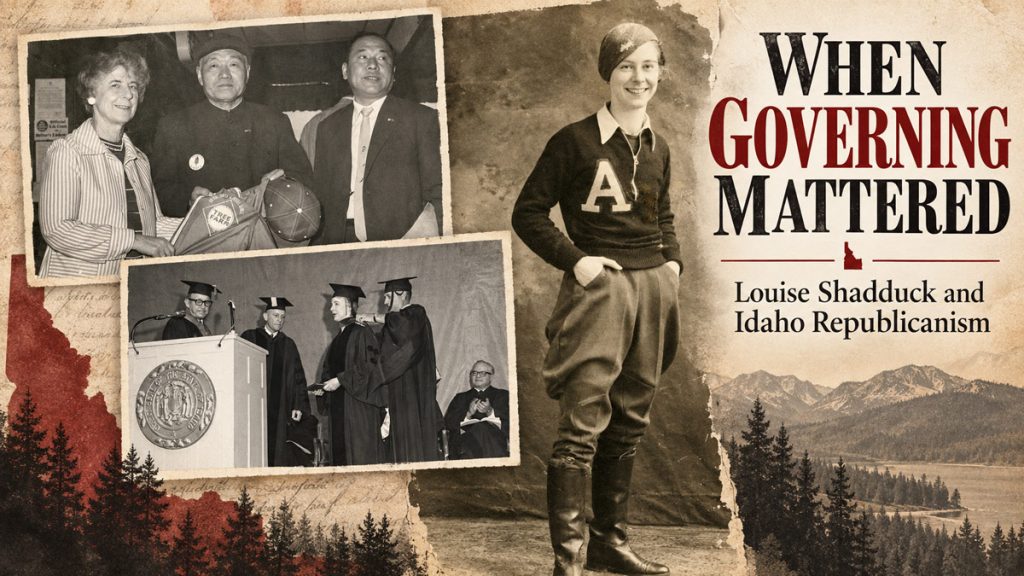
That question led me to Louise Shadduck, a remarkable North Idaho woman whose life offers a window into what it once meant to be an Idaho Republican.
The Lioness of Idaho

Louise Shadduck was born in Coeur d’Alene in 1915 and raised on a North Idaho dairy farm as the only daughter among six brothers. After graduating from high school in 1933, she began working as a journalist in Coeur d’Alene. Her ability as a writer and her involvement in Republican politics eventually attracted the attention of Senator Henry Dworshak.
Shadduck went on to work for Republican Governor Charles Robins and became Idaho’s first female gubernatorial administrative assistant. In 1956, she was the Republican candidate for Congress in a nationally watched race against Democratic Representative Gracie Pfost. It was reportedly the first congressional contest in American history in which both major parties nominated women.
Shadduck lost the election, but her public career was far from over. Governor Robert Smylie appointed her to lead Idaho’s commerce and development efforts. She became the first woman to head an Idaho executive department and one of the first women in the country to serve at that level of state government.
She would eventually become known as the “Lioness of Idaho.”
There should be no question about Shadduck’s Republican credentials. She worked for Republican elected officials, represented her party as a congressional candidate, participated in national Republican politics and spent much of her career promoting private enterprise and some of Idaho’s most important industries.
Yet she does not fit neatly into the narrow political boxes we use today.
Limited Government Did Not Mean Inactive Government
Shadduck reportedly took control of a department with only five employees and a budget of approximately $140,000. That was certainly not an example of sprawling government bureaucracy.
But neither was it an inactive office.
She used that small agency to recruit businesses, promote tourism, attract national gatherings and introduce corporate leaders to Idaho. Instead of simply mailing brochures, she took visiting executives horseback riding and fishing. She understood that people were more likely to invest in Idaho after experiencing the state and meeting the people who lived here.
She helped bring major Boy Scout and Girl Scout events to Idaho and was involved in the development and promotion of Farragut State Park. Later, she represented Idaho’s forest-products industry and traveled to China as part of a trade delegation.
Shadduck was unquestionably pro-business, but she apparently did not believe that being pro-business required government to sit silently in a corner. She believed government could help create the conditions in which private enterprise could succeed.
Her approach appears to have been straightforward: give government a legitimate and clearly defined responsibility, keep the operation lean and expect it to produce measurable results.
That is limited government. It is not no government.
Local Control Has to Apply When We Disagree

Republicans frequently speak about local control, and I believe they are right to do so. Decisions should generally be made as close as possible to the people affected by them. Families should have authority over family matters. Teachers and principals should be trusted to manage classrooms. Locally elected boards should make local policy. State government should intervene only when a problem truly requires a statewide response.
But local control means very little if we support it only when local communities are likely to reach our preferred conclusion.
A Republican may support prayer, reflection, patriotism, discipline and quiet in the classroom while still questioning whether the Legislature should prescribe a quiet minute for every public school in Idaho. Questioning the method does not necessarily mean opposing the objective.
That distinction has become increasingly difficult to express in modern politics.
Instead of asking whether a proposal is necessary, constitutional, affordable and assigned to the proper level of government, we increasingly begin with a different question: Are you with us or against us?
If you oppose a particular bill, your Republican credentials are questioned. If you question whether the state should act, you are accused of opposing the value the bill claims to promote. If the other party dislikes the proposal, some Republicans conclude that supporting it must therefore be the conservative position.
Policy becomes a loyalty test.
Conserving Is Not the Same as Controlling
Conservatism has traditionally included respect for families, communities, private institutions and the accumulated wisdom of people closest to a problem. It recognizes that centralized power should be restrained because even well-intentioned authority can eventually be placed in less trustworthy hands.
Political control operates differently. It identifies a preferred behavior or outcome and uses government authority to produce it.
Sometimes conservative principles and government action lead to the same policy. Government has legitimate responsibilities, particularly in protecting individual rights, maintaining public order and performing duties that cannot reasonably be handled privately.
But a desirable outcome does not automatically justify a state mandate.
The proper question is not merely whether a quiet minute is good. The question is whether deciding how the first minute of a school day is used belongs to the Idaho Legislature.
If Republicans no longer ask that second question, then “limited government” has stopped functioning as a governing principle. It has become a slogan applied only when someone else is exercising the power.
Shadduck’s Practical Republicanism

Louise Shadduck appears to have belonged to a generation of Idaho Republicans who believed in private enterprise, personal responsibility, efficient government and public service. They understood that governing required more than stating principles. It required making decisions, administering programs, watching costs and producing results.
Shadduck was partisan, but she was not defined exclusively by partisan combat. She promoted Idaho industries without treating every public investment as socialism. She helped develop state resources without assuming every government program was automatically justified. She also spoke against the Aryan organizations that were damaging North Idaho’s people and reputation, eventually supporting stronger remedies for victims of malicious harassment.
She seems to have evaluated public action by asking whether it served Idaho—not merely whether it satisfied one faction of the Republican Party.
That does not mean she would agree with me about the classroom-minute law. She may very well have supported it. The point is not to recruit a woman who died in 2008 into a current political dispute or pretend we know how she would vote today.
The point is that her career demonstrates a form of Republican leadership that was practical, confident and focused on accomplishing something.
A Better Test for Republican Government
Before passing another law, Republicans should be willing to ask several basic questions:
What specific problem are we solving? Is it government’s responsibility to solve it? Why must the state act instead of families, communities or local officials? Are existing authorities insufficient? What will implementation and enforcement require? How will we determine whether the law worked?
Most importantly, would we still support this exercise of government power if it were being used by political opponents to impose a value we did not share?
That last question reveals whether we truly believe in limited government or merely want control of it.
Louise Shadduck did not earn the title “Lioness of Idaho” by arguing that government should solve every problem. She also did not build her reputation by insisting government was incapable of accomplishing anything.
She worked within government, kept her attention on Idaho and expected public institutions to produce tangible results. Later in life, she became an author and historian, preserving the stories of the state she had spent decades promoting. Her papers, photographs, speeches and research are now maintained by the University of Idaho, providing a record of a Republican life built around service rather than performance.
Perhaps Shadduck’s lesson for today’s Idaho Republicans is not that we need fewer principles. It is that principles should help us govern wisely, not relieve us of the responsibility to think.
A quiet minute may be good for Idaho’s children. That does not automatically mean it requires an act of the Legislature.
A Republican Party confident in its principles should be capable of understanding the difference.
If you liked what you read, please share with your social network! Thanks.