When “Just Do It” Became “Just Don’t”
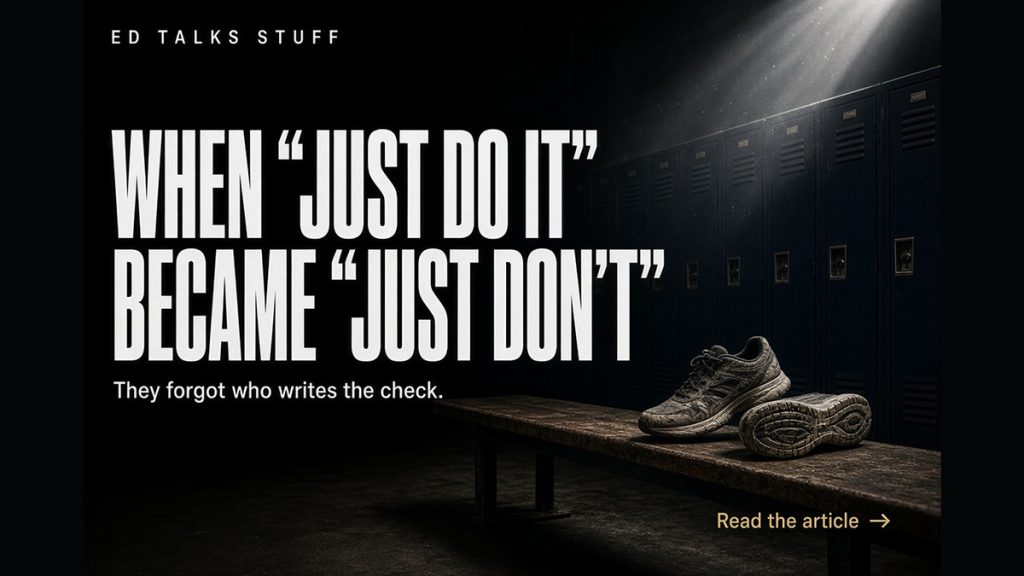
Nike used to be simple. You laced the shoes. You ran the hill. You got after it. The swoosh meant one thing: do the work.
This week the company that sold that idea to half the planet is getting shown the door from the S&P 100 after an 18-year run. The stock is sitting in the high $30s—down on the order of 75–80% from its 2021 peak, with more than $200 billion in market value gone. Revenue has stalled. Margins got skinny. China is a problem. Competitors are eating lunch. And then they rolled out those Specter Edition NBA jerseys that look like somebody spilled a screen saver on a practice jersey.
OutKick’s Craig Carton, who still calls himself a Nike guy, didn’t dance around it. He said they’re failing miserably. He pointed at the ugly jerseys. Then he walked backward through the last eight years: the 2018 Kaepernick “Dream Crazy” pivot that parked “Just Do It,” the Betsy Ross shoe they yanked, the 2020 slogan flip toward “Don’t Do It,” and the 2023 sports-bra campaign that put Dylan Mulvaney where Brandi Chastain used to stand. Carton’s line was blunt: they took a brand built on doing the thing and spent a decade telling a big slice of their customers they were the problem.
You can argue with his adjectives. You can’t argue with the scoreboard.
Nike didn’t fall only because of politics. That’s the lazy take. They also botched wholesale versus direct-to-consumer, lost ground in China, and watched On, Hoka, and a pile of hungry brands take the people who just wanted a shoe that didn’t lecture them. Index committees don’t care about your last Super Bowl ad. They care about market cap. Nike is no longer one of America’s 100 biggest companies by that measure. Tech names are taking the seats. That’s not a conspiracy. That’s arithmetic.
Here’s the part that belongs in this chair.
Most of the men I know—veterans, first responders, guys who still buy their own work boots—never asked Nike to be a political party. They asked it to make a decent shoe and stay out of the living room. When a company forgets who actually writes the check, it starts designing for the conference room instead of the customer. You can call that “values.” Customers call it “I’ll shop somewhere else.”
I’ve watched the same pattern in smaller shops around North Idaho. The ones that last treat the customer like an adult. They don’t need a new slogan every time the news cycle turns. They keep the product honest and the promise short. “Just Do It” worked because it was an order, not a sermon. The minute you replace an order with a lecture, half the room walks out. The other half waits to see if you’ll lecture them next.
Nike is not a one-off. It is one name on a long list of what happens when a culture that talks about freedom starts treating disagreement as a firing offense.
Cancel culture is not a campus hobby anymore. It is an economic weapon. It does not need a court. It needs a feed, a pile of one-star reviews, a human-resources department that would rather fire the target than defend him, and a mob that never has to sign its name. The point is not persuasion. The point is to make the next person keep his mouth shut.
We watched the method during COVID. A licensed, decades-old antiparasitic drug—ivermectin—became a political password overnight. I am not writing a medical paper. I am writing about what we did to people. Doctors who said, in public, that the question was worth asking were pulled from platforms, hauled in front of boards, and treated as if curiosity itself were malpractice. Ordinary men and women who mentioned it at the shop or on a Facebook page watched their names get attached to “horse paste.” If they were self-employed—the plumber, the dentist, the small-town clinic, the guy whose Google listing is his livelihood—the punishment did not wait for a hearing. It arrived as review bombs. One-star ratings from people who had never been a customer. Phone calls. Threats to “warn the community.” You do not have to win a scientific argument if you can wreck a man’s rating average and make his next customer hesitate. That is not public health. That is a protection racket wearing a lab coat.
The same machinery is running this month in a jury room in Massachusetts.
Lindsay Clancy admitted she strangled her three children in Duxbury in 2023: Cora, five; Dawson, three; Callan, eight months. The question before the jury was not whether the children were dead. It was whether she was criminally responsible, or whether postpartum psychosis meant a not-guilty finding by reason of mental disease or defect. After more than six days, the panel split 11–1. The judge declared a mistrial. The holdout was one man who would not sign the form the other eleven wanted signed.
That is how a jury is supposed to work. Unanimity is not a vibe. It is the rule. One citizen is allowed to stand there and say no.
What followed was the tell. Other jurors went on television and described him. A Boston station published a report on his alleged past, his finances, his family trouble. Florida’s governor put out a public offer of sanctuary if the man is being hunted. Read that sentence again. A state is offering refuge to an American juror because the country cannot be trusted to leave a deliberation alone. Whether you think the holdout was right or wrong is almost beside the point. The message to the next person called for jury duty is the point: vote with the room, or we will find you.
A republic cannot survive that habit.
Juries only work if twelve people can sit in a closed room and disagree without becoming a content target. Small businesses only work if a man can hold an unpopular opinion without having his livelihood firebombed by strangers. Brands only work if they sell to the country they actually have, not the country their marketing department prefers. When a movement demands conformity and calls the demand “progress,” it is not defending liberty. It is replacing it. And it is doing it in a nation whose entire operating system was built on the opposite idea: that a free people will not think alike, shop alike, pray alike, or vote alike, and that this is not a bug.
Demand conformity in a country that was founded on liberty and you do not get harmony. You get rebellion. Sometimes the rebellion looks like a boycott. Sometimes it looks like a stock chart. Sometimes it looks like a juror who will not raise his hand. Sometimes it looks like a customer who used to wear the swoosh and now buys something else without writing an essay about it.
Nike can still climb out. Brands this big usually get more than one life. But the climb starts the same place it always does: make something people want to wear, sell it to the people who buy it, and stop assuming the country is a focus group that owes you applause.
The rest of us will keep doing the thing we were going to do anyway. Lace up. Show up. Get after it. And refuse to be reviewed, doxed, or managed into silence for the crime of thinking for ourselves.
That’s still the only slogan that works.
If you liked what you read, please share with your social network! Thanks.
