
Working Because You Want To
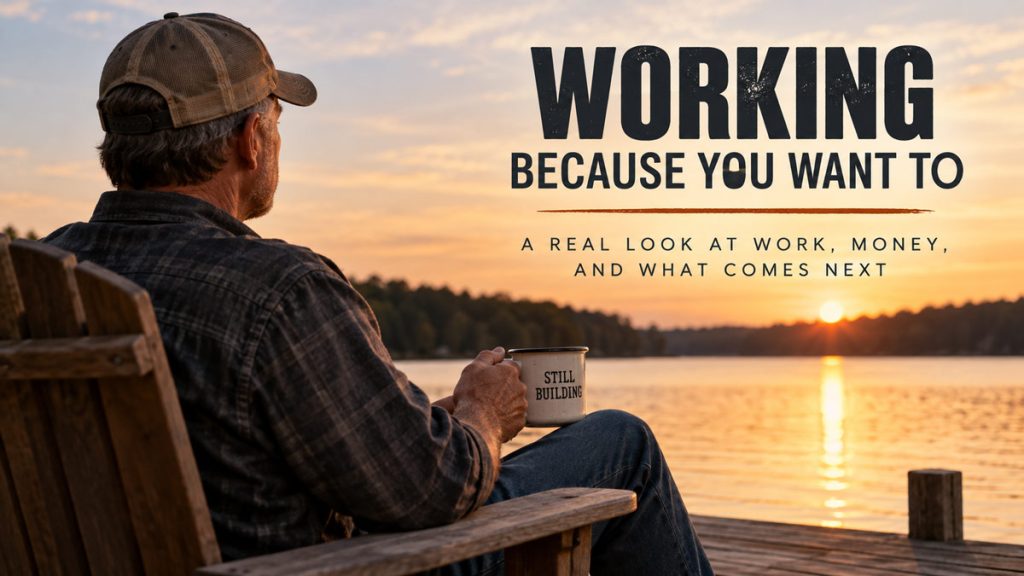
Somebody always asks it like they are being polite.
When are you going to retire.
They do not mean the date. They mean the costume. They mean the version of a man our age who has earned the right to disappear into a calendar with nothing on it. Golf, if he golfs. Grandkids, if he has them. A chair that faces the lake. A story he tells at dinner about how busy he used to be.
I am fifty-eight. I still have a shop. I still take the Tuesday morning networking meeting. I still build other people’s websites and then come home and try to build one that is mine. Kay has watched this pattern long enough that she no longer pretends it is a phase.
I am not retired. I also do not want to be pitied for that, or congratulated for it. Those are two different conversations that get mashed into one sentence.
There is working because you have to. There is working because you want to. From the outside they can look identical. Same truck in the same lot. Same phone that will not stay in the pocket. Same answer when somebody asks what you do.
They are not the same life.
The Brochure Sold a Cliff
For most of our working years the country sold us a picture. You labor. You save. At a round number somebody hands you a sheet of cake and the rest of the time belongs to you. The picture is tidy. It has to be. Tidy pictures sell mutual funds and recliner commercials.
A lot of men I know hit that number and discovered they had been sold a cliff.
Some of them needed the paycheck more than the brochure admitted. The house was not paid off. A parent needed help. A divorce had split the pile. Health insurance turned into a second mortgage with worse manners. Social Security arrived and did not cover what the calculator on television had implied it would cover. Those men are not failed planners. They are living in a country where a long life, a long bill, and a long list of things that used to be cheaper all showed up at the same party.
Some of them could have stopped. They just did not want the quiet that came with stopping. Work had been the place they knew who they were on a Monday. Take that away and the week gets long in a way nobody puts in the brochure.
I have sat across from both kinds of men. I have been both kinds of man, depending on the year.
The useful question is not “Are you retired.” The useful question is “Who is writing the schedule.” If the answer is the mortgage, that is one conversation. If the answer is you, that is another. Pretending they are the same conversation is how people either panic or perform.
Social Security Is a Floor. It Is Not a Personality.
Every year the government sends a statement that looks like it knows the rest of your life. A number at 62. A bigger number at full retirement age. A still bigger number if you wait until 70. People treat that page like a report card.
It is not a report card. It is a floor.
I was born in 1968. Full retirement age for my pile is 67. That is arithmetic, not destiny. Claiming early shrinks the check for as long as you live. Waiting grows it. Working while you take it can trim what you receive until you pass a line the government drew. None of that is a moral ranking. It is a set of levers, and the right lever depends on whether you need the money now, whether you expect to live a long time, and whether anybody else is eating from the same pot.
What the statement will not tell you is the part that actually decides the household. Can Kay get into the accounts if I get hit by a truck. Do you know which bills are automatic and which ones are hiding in a login you have not written down. Is the house a home or an expensive habit. Are you paying for a life you still want, or a life you wanted in 2009.
I am not a planner and I will not pretend to be one. I have watched too many men outsource the whole subject to a quarterly statement and then act surprised when the statement could not answer a human question. The check from Washington is one stream. A pension, if you still have one of those, is another. Savings are another. Work you still choose is another. Treat any one of them as the whole river and you will make a decision that looks clean on paper and ugly in March.
The other thing the statement will not say out loud: the age on the form is not a verdict on whether you are finished. Sixty-two is early only if you needed permission. Seventy is late only if you were keeping score against a commercial.
The Spending Question Is Usually a Values Question
Money after 50 gets discussed as if the only issue were quantity. Have I saved enough. Can I keep the house. What will a hospital cost. Those are real questions. They are not the only ones.
A surprising amount of the pressure in a household our age is not the big number. It is the little ones that never get a meeting.
The subscription that seemed cheap when it was six dollars and now has cousins. The truck payment that was justified by a job that no longer looks like that job. The club, the storage unit, the gadget that was going to pay for itself. The dinner out that is not a celebration so much as a habit with a receipt. None of those things is a crime. Stack enough of them and they start writing the schedule for you.
I have spent decades watching small businesses leak money the same way. Not on the dramatic mistake. On the quiet one. A tool they bought because it looked like growth. A contractor they kept because firing him felt rude. An ad that had not worked since the first quarter and still had a card on file. Households do it too. The difference is that a shop calls it overhead and a house calls it living.
Kay and I are not monks. I will spend money on food worth eating, on a tool that earns its drawer, on a trip we will actually take. I will not spend it to look like a man who is doing fine. Doing fine is a private condition. The performance of doing fine is how people stay on a payment they cannot explain.
Consumer life after 50 has a particular trap. A lot of the market is still aimed at a younger man who can outrun a bad decision. He can change jobs. He can refinance later. He can tell himself he will earn it back. You and I do not get as many of those later. That does not mean freeze. It means stop buying things whose only job is to tell the room you are not old.
If a purchase survives this sentence, it is probably honest: would I still want this if nobody else ever saw it.
What the Shop Taught Me That the Brochure Did Not
I have owned a web and marketing shop since 2007. Before that I spent years helping other people say what they knew. I have launched more websites than I care to count. I have sat in rooms with owners who were killing it and owners who were one slow month from a conversation with their spouse they did not want to have.
A few things survived all of that.
Cash is not a vibe. A business that looks busy and pays late is a hobby with letterhead. The customer who is decent, clear, and on time will keep you alive longer than the customer who sounds important. After 50 that sentence gets truer, because you no longer have twenty years to collect on a reputation.
Growth is a choice, not a commandment. I have watched men our age take on staff, leases, and a version of success that required them to become the person they were trying to stop being. More revenue with less life is not a promotion. It is a relapse.
Showing up still beats the story you tell about showing up. Elite Business Connections meets on Tuesday mornings in Coeur d’Alene. I am the secretary. The useful part of that room is not the slogan. It is watching who keeps a promise when there is no camera. Referrals follow trust. Trust follows repetition. That was true when I was younger. It is the whole game now.
Most “passive income” is a man selling you a map to a place he does not live. If a thing were truly passive, he would be doing it quietly, not explaining it on a stage. There is honest side income. I have written about that kind — small, local, built on a skill you already have, sized to the week you actually want. There is also a product that uses the word freedom the way a timeshare uses the word vacation.
The work that lasts is usually narrower than the work that impresses. A few clients who need what you know. A list you own. A reputation that can survive a bad month. That is not thinking small. That is thinking like a man who intends to still like his life in ten years.
You Can Want the Work and Still Refuse the Old Job
Wanting to work is not the same thing as wanting the job that used you up.
I still want problems in front of me. I still want a reason to know what day it is that is not a doctor’s appointment. I still want to be useful to a customer, a veteran at a Tuesday table, a reader who did not come for a performance. That is not restlessness. That is the habit the Army put in me and the shop never took out. You show up. You do the work in front of you.
What I do not want is a schedule that pretends I am thirty-five. I do not want a boss who thinks experience is a cost. I do not want to rent my name to a platform that can change the rules on a Thursday. That is why this site exists, and it is why the shop still exists in the shape it exists. The work stayed. The terms changed.
A lot of men our age only know one version of effort: forty hours, somebody else’s building, a title that used to mean something in a hallway. When that version ends they think the alternative is a blank week. It is not. The alternative is work you chose the size of. Ten hours. Twenty. A season. A project. A morning with people who still need a table. You can get paid for some of it and not for the rest. Both can be real work.
The danger is pride. Pride will keep you in a job that is eating the years because leaving looks like losing. Pride will also invent a business that is just the old job with your name on the door. I have made versions of both mistakes. The correction is the same sentence I used about passwords and about this website.
You do not have to become a different man. You have to stop living inside a design that was not built for the life you have now.
So Which Life Are You Buying
I cannot tell you whether you should claim at 62 or wait. I cannot tell you whether to sell the house. I cannot tell you whether the side work is a bridge or a stall. Those answers live in a kitchen I do not sit in.
I can tell you the difference that matters.
If you are working because the bills require it, treat that with respect. It is not a character flaw. Get honest about the floor. Cut the expenses that were only ever there to impress a room. Use the skill you already have before you buy a new identity. Leave a way into the accounts for the person who loves you. Do not let shame make the math worse.
If you are working because you want to, say that out loud. You are allowed. You do not owe the brochure a disappearing act. Choose the hours. Choose the customers. Choose work that still feels like yours when nobody is watching. Take the money if the money is honest. Take the Tuesday morning if the Tuesday morning keeps you in the world.
And if you are somewhere in the middle — which is where most of us live — stop waiting for a feeling of certainty that does not visit men with mortgages and bodies and wives named Kay. Make the next useful decision. Then make the one after that.
Retirement was never the point. The point was a life you could stand to be inside of when the paycheck stopped being the whole story.
I still work. Some days that is necessity with a better attitude. Most days it is because I am not finished, and I would rather spend the years that are left on something that still answers when I knock.
That is not a financial plan. It is the reason a financial plan exists.
If you liked what you read, please share with your social network! Thanks.